1. Vision & Origins: Beyond the Breadboard Blink
Around 2 or 3 years ago I first started dreaming of teaching or tutoring some sort of robotics class. Being able to share the knowledge, and the keys to mechatronics that I learnt through my years of experience, was a beautiful dream of mine. Before my senior year, I knew I had to do something about it, so I began preparing, and brought my ideas into reality. And thus, the club was started!
When students think of high school STEM or robotics clubs, the image that usually comes to mind is predictable: plugging pre-built plastic kits together, copying a few lines of visual block code, or wiring a single LED on a solderless breadboard to blink every 1,000 milliseconds. While these exercises have initial educational merit, they often leave an enormous chasm between classroom hobbies and authentic engineering.
Real engineering isn't isolated. It lives at the volatile intersection where mechanical tolerances, analog noise, power electronics, and low-level firmware collide. In industrial engineering, this friction is notorious: it is colloquially known as "Integration Hell", the state where individual mechanical components and software routines function in isolation, but immediately destabilize when unified into a single mechatronic machine.
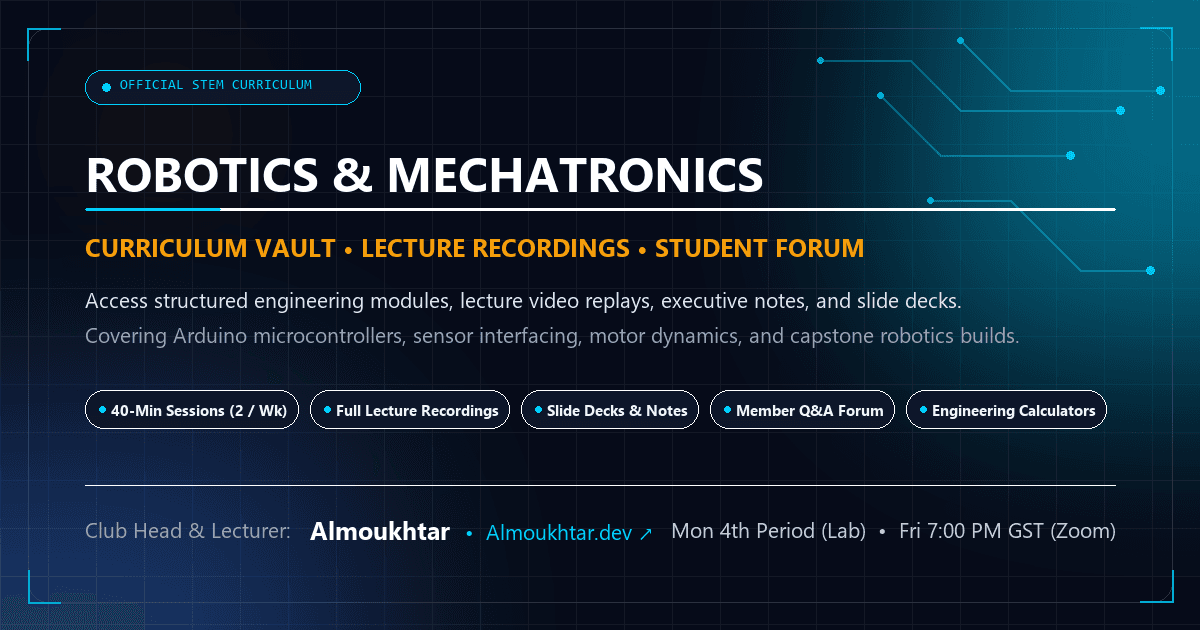
To dismantle this barrier and provide students with real-world engineering experience, I founded and head the Robotics & Mechatronics Club at PEPS (hosted publicly at pepsroboticsclub.com). My goal was to create a structured, university-grade pre-engineering pipeline that guides members from foundational physics and metrology all the way to designing custom 3D-modeled multi-axis autonomous robotic arms.
2. Core Philosophy: Mechatronics vs. Pure Robotics
In our very first session, we established a foundational definition that frames every lesson we teach:
"All robots are mechatronic systems, but not all mechatronic systems are robots."
Students frequently conflate the two domains. We dissect this distinction from first principles:
- Mechatronic Systems: Broad electromechanical machines that combine mechanical linkages, electrical circuitry, and microcontrollers to perform automated tasks without requiring dynamic spatial adaptation. A prime example is an industrial CNC milling machine or automatic sliding door: it follows deterministic, pre-programmed toolpaths, but lacks environmental awareness.
- Robotic Systems: Specialized subclasses of mechatronics featuring multi-axis articulated kinematics, real-time spatial sensing, and closed-loop environmental adaptation. Examples include the Boston Dynamics Spot quadruped (which continuously recalculates leg torque to preserve balance over uneven terrain) or NASA's Mars Perseverance Rover (which autonomously navigates obstacle fields millions of kilometers from Earth).
To bridge the gap between these disciplines, the club trains members across a Tri-Discipline Skill Matrix:
- Mechanical Engineering: Precision metrology (calipers, micrometers), parametric 3D CAD modeling in Autodesk Inventor, additive manufacturing (FDM), gear reduction mechanics, and ISO metric fastener standards.
- Electrical Engineering: Power rail regulation, breadboard prototyping, signal conditioning, analog-to-digital conversion, and motor drivers.
- Software Engineering: Embedded C++ on Arduino microcontrollers, non-blocking state machines, hardware communication buses (I2C, SPI, UART), and cross-platform UI development.
3. The 5-Module Modular Curriculum
The club follows a comprehensive 11-session syllabus split across 5 progressive modules. Designed to run in 40-minute blocks twice a week, the curriculum balances theoretical lectures with tactile, hands-on workshop labs.
| Module | Focus & Core Domains | Sessions Included |
|---|---|---|
| Module 1: Foundations & Workshop Prep | Mechatronic definitions, systems integration, workshop metrology, and electrical diagnostics. | Sessions 1 & 2 |
| Module 2: Sensing, Actuation & Mechanics | Sensor perception hierarchies, IMU fusion, motor physics, gear transmissions, and ISO metric hardware. | Sessions 3 & 4 |
| Module 3: Arduino Hands-On Practical Labs | Digital logic, pull-up resistors, debounce state machines, ADC sampling, PWM mapping, and I2C LCDs. | Sessions 5, 6 & 7 |
| Module 4: Digital Manufacturing & CAD Design | FDM 3D printing physics, anisotropic strength, parametric Autodesk Inventor modeling, and reverse engineering. | Sessions 8 & 9 |
| Module 5: Connectivity & System Integration | Wired buses (UART/I2C/SPI) vs. wireless (ESP-NOW/BLE/Wi-Fi), MIT App Inventor UIs, and PCB layouts. | Sessions 10 & 11 |
4. Inside the Sessions: Foundations in Action
Rather than walking through every session in exhaustive detail, our curriculum structure is best illustrated through a look at how we introduce core concepts. In Session 1: Introduction to Robotics & Mechatronics: Engineering the Future, we set the stage for how real engineers think about systems integration:
- Tackling "Integration Hell": Analyzing real-world failures where mechanical tolerances didn't account for motor heat expansion, or where digital sensors reset due to voltage sags on shared power rails.
- The 4 Specialization Pathways: Introducing students to career trajectories across Autonomous Systems Engineering, Industrial Automation, Embedded Firmware, and Mechatronic Systems Architecture.
- The Term Milestone: Unveiling our term capstone project, a 4-DOF articulated desktop robotic arm, to establish clear engineering milestones early on.
You can watch the full recorded lecture stream from Session 1 below:
📺 Watch the Entire Curriculum on YouTube
We record and archive our sessions so members can revisit theoretical derivations, circuit diagrams, and live code walkthroughs anytime. You can explore the full sequential lecture playlist (covering sensor perception, engineering metrology, motor dynamics, and metric assembly standards) on our official YouTube channel:
👉 Watch the Complete Robotics Club Curriculum Playlist on YouTube
Full presentation slide decks (.pptx) and executive summary notes (.pdf) for all covered sessions are also directly downloadable on our club platform at pepsroboticsclub.com.
5. Building the Web Platform: pepsroboticsclub.com
To support our members beyond physical classroom hours, I engineered and deployed a dedicated digital platform from scratch: pepsroboticsclub.com. Rather than scattering resources across disconnected cloud drives or chat channels, the portal acts as a unified engineering ecosystem.
Key Architectural Highlights:
- Session Resources Vault: Every session card features slide decks (
.pptx), technical summary notes (.pdf), curated reference guides, and an embedded multi-part video stream switcher. - Direct YouTube Data API v3 Upload Studio: An in-browser uploader built directly into the instructor dashboard. Using OAuth 2.0 and chunked resumable uploads, new lecture recordings can be published to the club's YouTube channel and instantly embedded into the portal without touching code.
- Student Discussion Forum with Supabase Sync: A real-time Q&A forum where students ask troubleshooting questions, paste Arduino code, and upload circuit photos. Features include verified instructor badges, solved question markers, client-side photo compression (~98% payload reduction), and instant multi-device cloud synchronization.
- Member Authentication & Revision Tracking: Secure registration with client-side SHA-256 password hashing, self-service 4-digit PIN recovery, and persistent PDF revision checklists tied to each student profile.
- Interactive Engineering Calculators:
- 4-Band Resistor Color Calculator: Real-time visual band rendering that calculates required series resistance and forward LED current using Ohm's Law:
- Gear Ratio & Torque Multiplier: Dynamic input calculator for gear teeth counts, motor RPM, and input torque to simulate mechanical speed reduction and torque amplification:
6. Term Capstone: The 3 to 4 DoF Desktop Robotic Arm
To synthesize everything members explore across CAD modeling, digital manufacturing, circuit wiring, and firmware control, the club will collaborate on a multi-axis desktop robotic arm (3 to 4 Degrees of Freedom) as our culminating capstone project.
Rather than assembling a rigid pre-packaged kit, the goal is to involve members in the actual engineering decisions: dimensioning structural links, testing servo actuation under load, wiring dedicated power rails, and programming coordinated joint movement. Specific hardware choices, bracket geometries, and kinematic limits will be determined collectively as we progress through our workshop labs.
7. Meeting Logistics & Workshop Operations
The club operates under a structured hybrid format to maximize both lab bench time and deep theoretical exploration:
- Session 1 (In-School Lab): Mondays during 4th Period Break () in the Engineering Lab. Dedicated to physical breadboarding, multimeter measurements, 3D printer calibration, and robotic assembly.
- Session 2 (Online Lecture): Fridays at Dubai Time (GST, UTC+4) via Zoom. Dedicated to slide deck lectures, kinematics mathematics, firmware walkthroughs, and open Q&A.
- Student Kit Requirements: Entry-level Arduino Starter Kit and a laptop capable of running the Arduino IDE.
8. What's Next for PEPS Robotics
Leading the Robotics & Mechatronics Club has been one of the most fulfilling milestones of my journey. Watching fellow students step into the workshop, get hands-on with multimeters and microcontrollers, and steadily build up their engineering intuition proves that young makers are ready for genuine engineering challenges when given the right structure and mentorship.
If you would like to follow our progress, explore the lecture recordings, inspect the slide decks, or read the technical notes, visit the official club platform at: 👉 pepsroboticsclub.com